
Kinmuck
The hamlet of Kinmuck is about 14 miles northwest of Aberdeen. There, in about 1662/3, the largest community of Quakers in Scotland was based on land given to Friends by the family Jaffray of Kingswells.
The first Quaker school in the country opened there in 1681 in the cottage beside the Meeting House, teaching ‘the Latin toung and other commendable learning’. The community flourished, with cobblers, tailors, blacksmiths and a wool mill. The school closed in 1807, but annual meetings were held until the Second World War. The Meeting House no longer belongs to the Society of Friends.
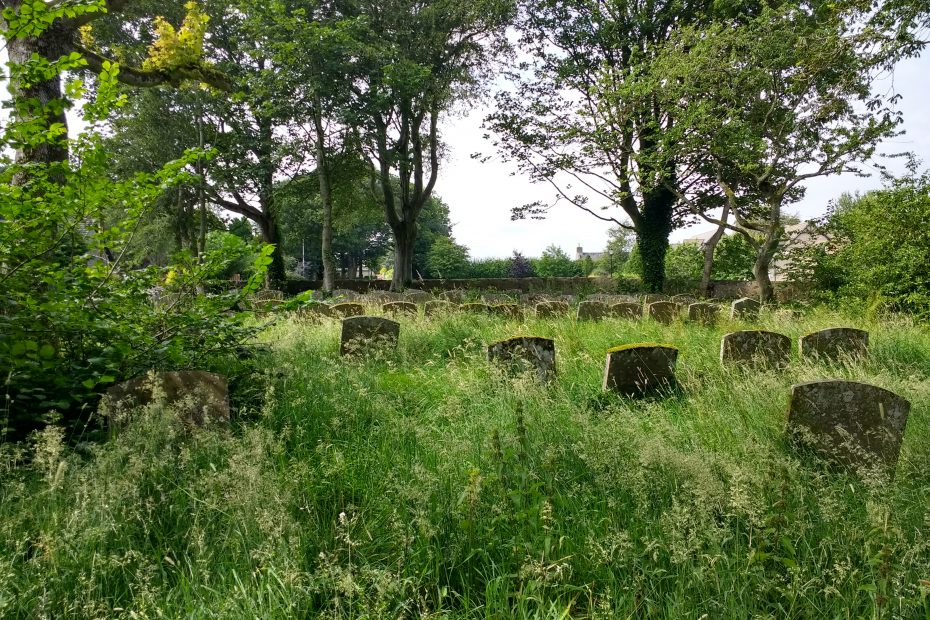
Across the road, the rectangular burial ground was associated with the parish of Ellon, northwest of Aberdeen. The earliest recorded burial is 1710, but there may have been earlier burials, as headstones were not in keeping with early Quaker beliefs. All but one of the headstones are of a simple design, a sandstone slab with a semicircular top and V-cut letters.
It is recorded that an Aberdeen Friend, Hamish Milne, was holidaying in Kinmuck as a small boy. He was fascinated by the lid of the Quaker mort safe with padlock, key and spanner, formerly in the corner of the graveyard. It is said to be now in the Museum of the Medical Department of Aberdeen University.
For many years this burial ground was cared for by Ann & Colin Millar, members of Aberdeen Meeting.
Kingswells
Kingswells burial ground lies close to the new A90 road, 4½ miles west of Aberdeen, and only 200 yards north west of the 17th century manor house of Kingswells, which belonged to the Jaffrey family. Alexander Jaffrey, a famous provost of Aberdeen who did a lot to enrich the lives of his fellow citizens, is buried here.
Jaffrey became a Friend in 1662, and was largely responsible for the founding of the community of Kinmuck. Kingswells meeting house might have been demolished when the gardens of Kingswell House were developed.
The names of ten people are recorded as buried at Kingswells, half of whom belonged to the Jaffrey household. None of the graves is marked.
The burial ground, dating from before 1673, lies in the middle of a field with no path to it. It was once surrounded by a wall which became ruinous and was repaired, and there is no longer a gate into the burial ground. The graveyard is largely overgrown with trees.

Ury
A few miles northwest of Stonehaven, and 14 miles south of Aberdeen, there was a burial ground at the village of Ury. Little remains there now except the ‘Houff’, the burial vault of the Barclay family.
Ury House is now a ruined mansion. It is recorded that Colonel David Barclay purchased ‘Urie’ in the late 1660s and his descendants owned it until 1854. In the 17th century Ury was established, by David Barclay, as the centre of north-east Scotland’s Quaker movement.
The second laird was Robert Barclay, the Quaker apologist, theologian & author, who was interred in the burial ground in 1690, aged 41yrs.
Aberdeen
We know, from the old records, that there was a burial ground on the Gallowgate opposite the site of the college, which possibly now lies under the present high-rise flats, or just to the west of them. This was used for burial from 1672 but can no longer be seen.
The purchase of the land was funded by Robert Barclay and his friend, the Viscountess Conway of Ragley Hall, Worcestershire. Aberdeen Quakers were persecuted during this period, and the walls of the burial ground were repeatedly demolished by the town council.
Mary Dower, Aberdeen Local Meeting
With additional information from www.canmore.org.uk